Marine Lake in metal: an old Southport printing block
In 2012 a friend let me examine an old metal printing block showing Southport Marine Lake and its landmarks. Its date and purpose are uncertain; an archaeologist put the typeface at around 1890 to 1920.
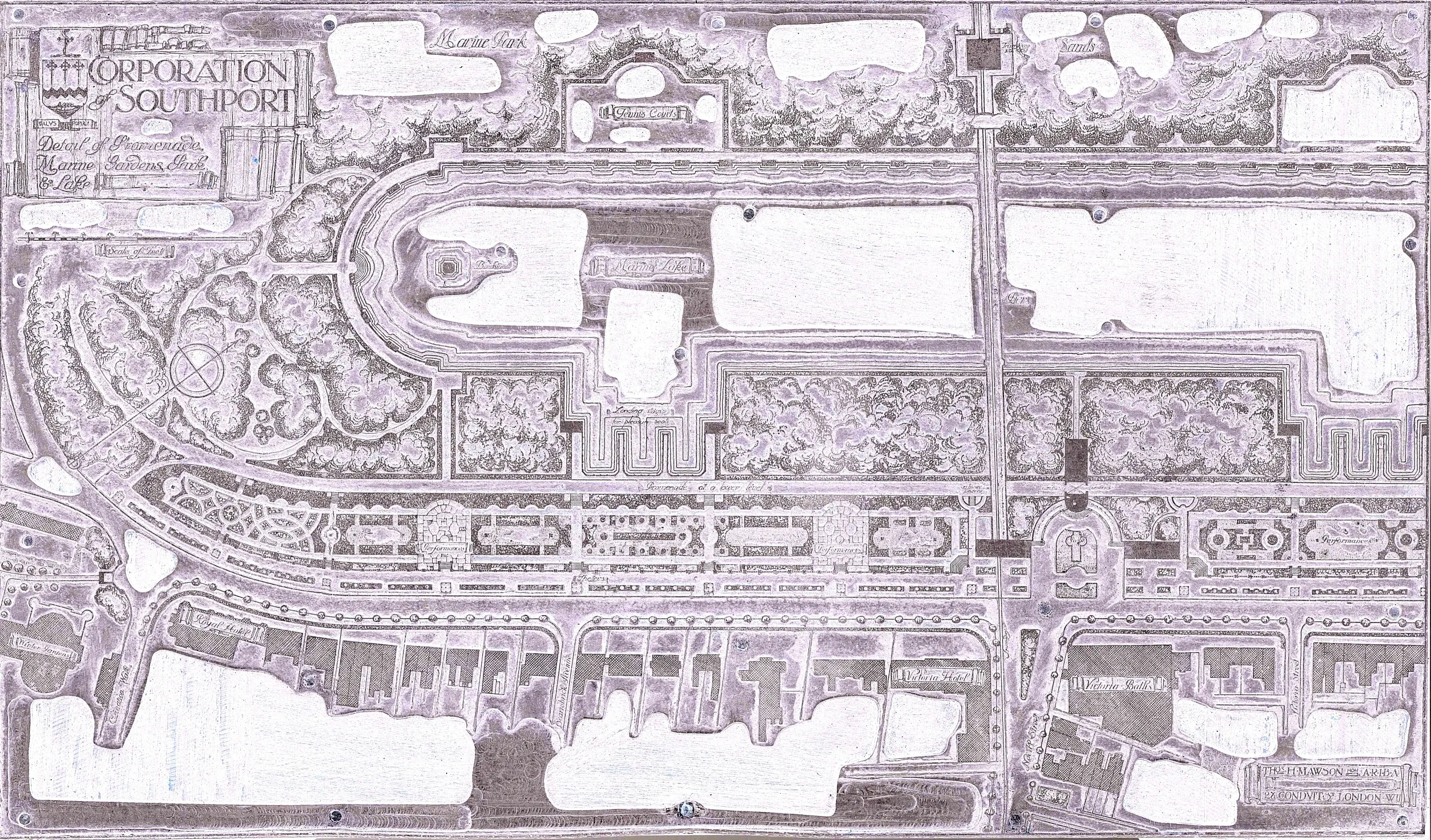
In 2012 a friend let me examine an old printing block he had been given. It is a worked piece of metal, the kind once locked into a press to print an image, and what it carries is the marine lake at Southport, drawn in fine detail.
Look closely and the landmarks of the period are there: the bandstands, the Victoria Hotel, the Victoria Baths, the paths and gardens laid out around the water. It is a snapshot of the town as it once presented itself.
What we know, and what we do not
The block’s origins are uncertain. When it was made, what it was for, who commissioned it: none of that came with it.
Mark Adams, an archaeologist at the Museum of Liverpool, looked at the typeface and put it at roughly 1890 to 1920. That is as firm a date as I have, and it is an informed reading of the lettering rather than a documented fact. I am keeping that distinction, because a typeface tells you when a style was in use, not necessarily when this particular block was cut.
A Southport in the making
Those three decades were a transformative time for the town. The marine lake became the centre of its leisure, with attractions arriving around the water one after another. A block of this size could have served any number of ends: a promotional poster, a postcard, something to put the resort in front of visitors who had not yet come. I can speculate about which, but I cannot prove it.
For anyone drawn to local history, the block is a direct, physical link to that Southport. A thing you can hold, made to be pressed onto paper, that has outlived the paper and most of what it showed.
I would still like to know what it was made to print. If you know how blocks like this were used in the late nineteenth and early twentieth centuries, or you recognise this view of the lake, I would be glad to hear from you.